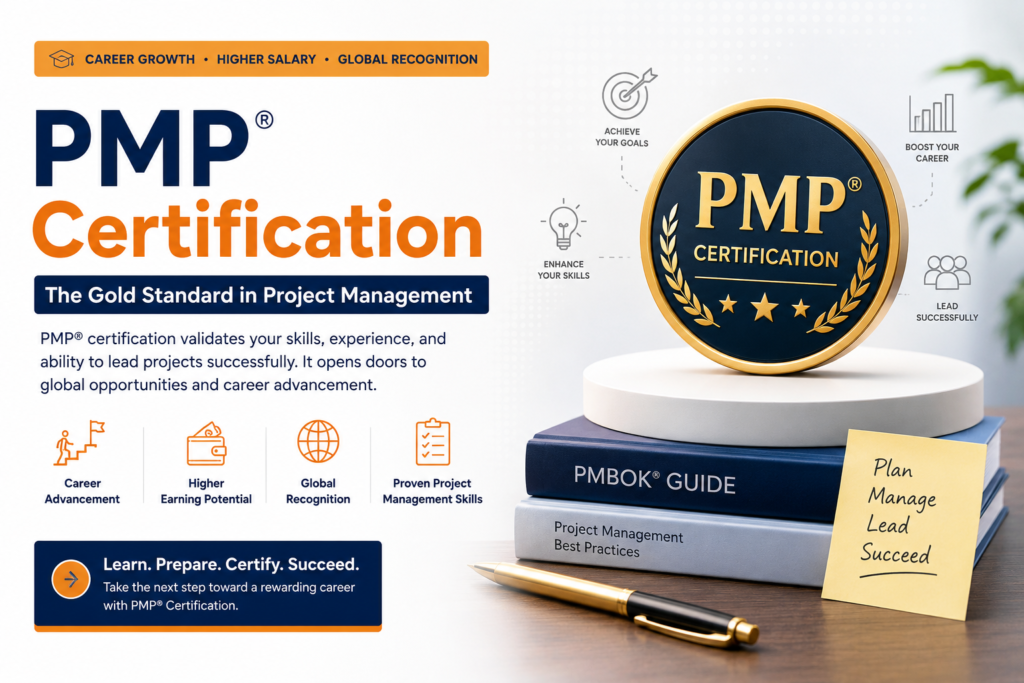
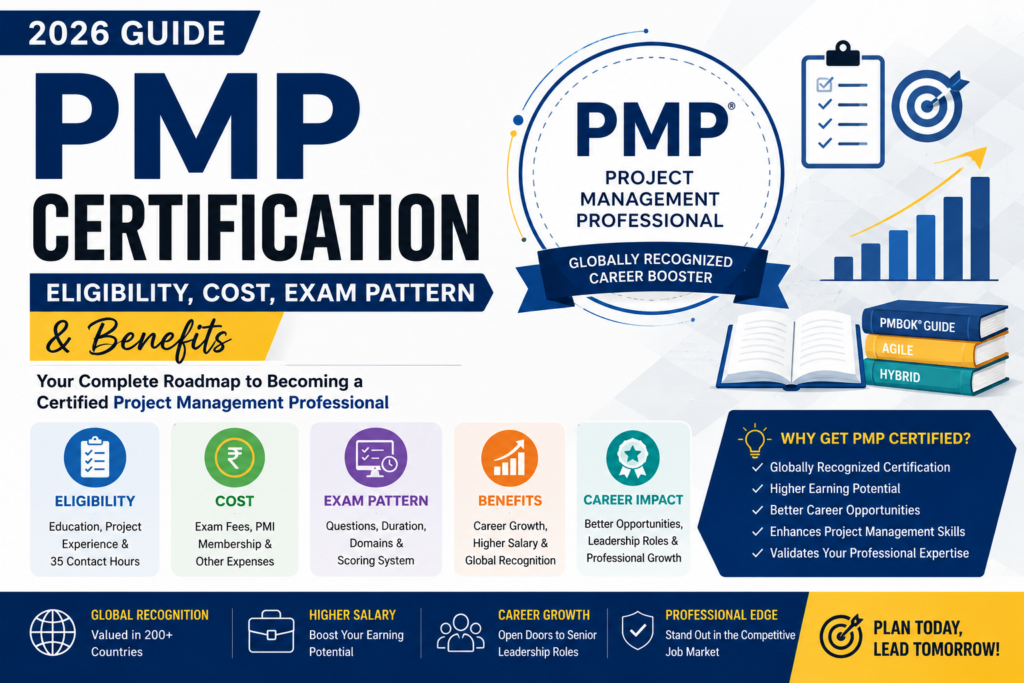
The Project Management Professional (PMP) certification is one of the world’s most respected credentials for project managers. Awarded by the Project Management Institute (PMI), it validates your ability to lead projects using predictive, agile and hybrid approaches.
Table of Contents
- What is PMP Certification?
- Why Choose PMP?
- Eligibility Criteria
- 35 Contact Hours
- PMP Certification Cost
- Exam Pattern
- Syllabus
- Application Process
- Preparation Tips
- Career Benefits
- FAQs
What is PMP Certification?
PMP is a globally recognized certification designed for experienced project professionals. It demonstrates knowledge of project planning, execution, stakeholder communication, risk management, budgeting, quality management and leadership.
PMP-certified professionals are recognized across industries including IT, construction, healthcare, finance, manufacturing and consulting.
Why Choose PMP Certification?
- Improves career opportunities
- Increases earning potential
- Demonstrates global project management skills
- Builds confidence in managing complex projects
- Recognized by employers worldwide
PMP Eligibility Criteria
| Education | Experience |
|---|---|
| Bachelor’s degree or equivalent | 36 months leading projects |
| High school diploma or associate degree | 60 months leading projects |
All candidates also need project management education (commonly referred to as 35 contact hours) or an eligible alternative accepted by PMI.
What Are 35 Contact Hours?
These are formal project management training hours completed before applying for the exam. Many online training providers offer qualifying courses.
PMP Certification Cost
| Expense | Description |
|---|---|
| Exam Fee | Depends on PMI membership status and local pricing. |
| Training | Varies by provider. |
| Study Materials | Books, mock tests and practice exams. |
PMP Exam Pattern
- 180 questions
- Scenario-based format
- Predictive, Agile and Hybrid topics
- Questions from People, Process and Business Environment domains
PMP Exam Syllabus
People
Leadership, communication, conflict management and team performance.
Process
Planning, scheduling, risk, quality, procurement, integration and stakeholder engagement.
Business Environment
Compliance, value delivery and organizational strategy.
How to Apply
- Create a PMI account.
- Verify eligibility.
- Complete the application.
- Submit project experience.
- Pay the exam fee.
- Schedule your exam.
Preparation Tips
- Create a 90-day study plan.
- Understand the PMI mindset.
- Practice hundreds of scenario-based questions.
- Take multiple mock exams.
- Review mistakes regularly.
Career Benefits
PMP certification can strengthen your professional profile, improve leadership skills and increase opportunities for project management roles in multiple industries.
Frequently Asked Questions
Is PMP difficult?
It is challenging because the exam emphasizes practical decision-making rather than memorization.
How long should I prepare?
Most candidates prepare for two to four months depending on experience.
Is Agile included?
Yes. Agile and Hybrid project management form an important part of the exam.
Conclusion
PMP certification remains one of the most valuable professional credentials for project managers. With a structured study plan, the right resources and consistent practice, you can significantly improve your chances of passing the exam and advancing your career.
📘 Recommended Reading
Before preparing for the PMP certification exam, build a strong foundation by exploring our comprehensive PMP Exam Concepts Guide . It covers the three PMP domains, Agile concepts, formulas, PM mindset, process groups, knowledge areas, and other essential topics that every candidate should understand. :contentReference[oaicite:0]{index=0}